
Update on AI in Construction
Applications, announcements and acquisitions by industry majors

This update covers recent developments in construction related artificial intelligence (AI). Although it includes an overview of startup funding and concludes with a couple of research papers on economic policy, the focus is on announcements and acquisitions by construction industry majors in contracting, equipment manufacturing, and software, because those large companies are driving AI adoption in the industry. For example, in December 2025 Dodge Construction Network released AI for Contractors and found that 86% of large US contractors believe AI will give them a competitive advantage, compared to 69% of small or mid-sized contractors. The cost of investing in AI was an issue for 49% of smaller firms, but for only 26% of large firms.
Dodge surveyed more than 230 general and trade contractors across the US, so their survey is certainly not representative of the world and probably not of the entire US industry. The survey found although AI adoption was limited, more than half the surveyed companies were actively exploring AI through pilot programs and preparing staff for AI-related roles:
40% allocate a dedicated budget to AI;
38% are creating implementation teams;
19% report adapting legacy workflows for an AI environment;
51% are actively evaluating AI-related changes across their teams.
Doge also found over half of contractors had concerns about data accuracy (57%) and security (54%), and over a third had concerns about implementation costs and internal resistance. The biggest challenge to use of AI in construction is data quality, with only 26% of contractors rating their current data quality as high.
The post starts with what may have been the most important announcement in 2025, by Autodesk on the foundation models they are developing and call Neural CAD. The topics this post covers and the companies included are:
Autodesk AI – Neural CAD and Forma Building Design;
AI agents for construction - Procore, Trimble, Samsung C&T, Turner Construction, Skanska, and evaluating AI agents;
Autonomous equipment – Caterpillar, Komatsu, Doosan Bobcat, and NVIDIA;
UK digital team awards – Balfour Beatty and LSI Architects;
Mergers and acquisitions – Procore, Lennar, John Deere, Bentley, AECOM, Bluebeam;
Startups and venture capital funding - individual startups are not included.
Autodesk AI
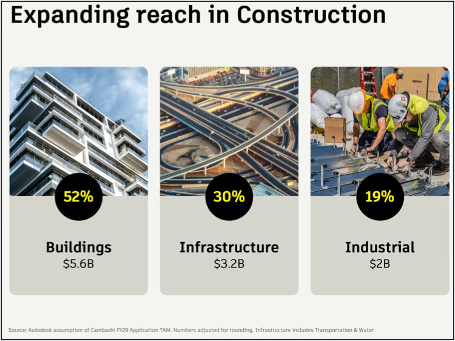
Autodesk has a dominant position in design and engineering software, and their computer-aided design (CAD) software is essential in manufacturing, architecture, and engineering. There is an enormous product family (see the product documentation page for how many products) but it is actually a complex ecosystem. The important point is that, when market shares of products like AutoCAD, AutoCAD Mechanical, Civil 3D, Autodesk Build, BIM Collaborate Pro, Autodesk Construction Cloud, and Revit are combined, Autodesk has over half the global market. It may not quite be a monopoly, but it is dominant. The October 2025 Investor Day presentation by CEO Andrew Anagnost included this slide on market share:
Figure 1. Autodesk market shares in 2025
The Investor Day presentation from Chief technology officer Raji Arasu showed Autodesk’s strategy, built on three categories of AI: core AI improves the performance of products; agent AI is Autodesk Assistant, an agentic ‘partner for design and make’; and neural AI, because ‘Neural technologies are key to systems automation.’ Autodesk’s Neural CAD are two industry-specific foundation models trained on design data to reason about geometry and building systems. One version is Fusion, for manufacturing, while Forma is for buildings.
In fact, in September 2025 Autodesk (in a blog post) opened the waitlist for the beta version of Forma Building Design, calling it a cloud-based system that ‘combines easy-to-use modeling tools, generative AI, and real-time analysis.’ It links to the Forma Site Design system that also uses AI assisted generative design for ‘concept massing and geometrical analysis’ to automate site layouts, analyse daylight, wind and noise, and get carbon estimates.
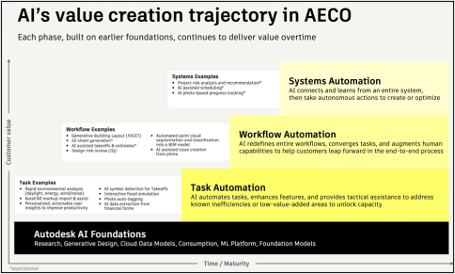
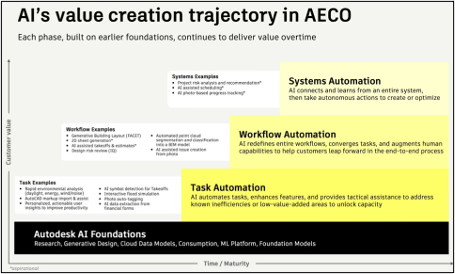
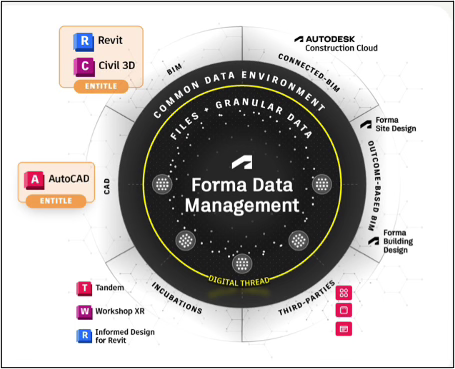
The Investor Day presentation from Amy Bunszel, VP for Architecture, Engineering and Construction, had two relevant slides. The first in Figure 2 shows examples of AI use in design, with the last step of Systems Automation being ‘aspirational’. The second in Figure 3, showed Forma working as a data hub linking to other products.
Figure 2. Autodesk AI examples
Autodesk describes Forma as the ‘first end-to-end industry cloud for architects, engineers, contractors, and operators.’ Forma Building Design ‘will support the AI-driven creation of advanced details for structural elements and floor plans.’ It should be noted here that the data Autodesk is using to build their Neural CAD foundation models is the thousands or maybe millions of projects of all types done in products like Revit, AutoCAD and BIM 360. No startup has access to that amount or diversity of training data, and Autodesk’s terms of use allows them to use ‘aggregated and de-identified data for R&D’ and prevents users from developing their own models. Given that, Autodesk is probably the best placed company to build a foundation model for AI in construction.
Figure 3. Autodesk Forma
The significance of the industry foundation models Autodesk is developing cannot be overemphasised. That is because the specific spatial and graphical language of architectural drawings remains ‘largely opaque to the large language models and their current vision systems.’ The quote is from a benchmarking report by AEC Foundry on ‘10 state-of-the-art multimodal & vision models’ that included Gemini 3 Pro, GPT-5.2, Claude Opus 4.5, and GLM 4.6. Their report concluded: ‘Existing models are powerful enough to deliver substantial value as document and information assistants around drawings. Their capabilities in OCR, metadata extraction, and text-based reasoning are impressive and improving rapidly. But they fall short of genuine drawing literacy: understanding symbols, geometry, and code-relevant semantics robustly enough for autonomous decision-making on tasks that matter.’
AI Agents for Construction
AI agents can process information like text, voice, video, audio, and code, and can converse, reason, and make decisions to facilitate transactions and business processes. They learn from experience and improve over time, and can work with other agents to coordinate and perform tasks. The features of an AI agent are reasoning and acting autonomously to achieve a goal. Autodesk’s Assistant agent was mentioned above (‘an agentic interface, which detects user intent from prompts, routes them to multiple agents, orchestrates and coordinates complex tasks to complete a user workflow.’)
Procore
Released in January 2026, Procore Helix is an AI system within their construction management platform that automates tasks and provides real-time analytics. It runs in the background and helps anticipate project issues. ‘Helix takes static project data – from site diaries and submittals to observations and RFIs – and transforms it into dynamic intelligence that teams can take action on.’ Procore Assist, formerly known as Copilot, is their chatbot and in January had photo analysis added for project tracking and safety. Also in January, the beta version of Procore’s Agent Builder was released, that allows users to create task-specific agents with natural language prompts.
Trimble
At the annual Trimble Dimensions user conference in November 2025, Trimble set out ‘the company’s vision for accelerating the development and expansion of agentic AI in engineering and construction workflows.’ It announced that it is piloting the Trimble Agent Studio platform with select customers. Its agentic AI platform is designed to be open and extensible and will ‘unlock industry-scale innovation by empowering partners and customers to create and deploy AI agents and multi-agent workflows across Trimble’s suite of construction solutions.’
Trimble Labs (Labs) is a pre-release, early engagement program that enables customers to test new features and provide user feedback. From the press release:
Viewpoint Finance Assistant and Accubid Assistant agents (both demonstrated at Dimensions 2025) are expected to be in Labs in early 2026.
Trimble ProjectSight Help Agent, Auto-Submittals and the AI Title Block Extraction capability are available now in North America.
AI Render capability in Trimble SketchUp is now available. SketchUp Assistant and Generate Object are expected to be available in Q4 2025.
Tekla Structures User Assistant, Developer Assistant and AI Cloud Fabrication Drawings capability are now available. The Tekla Model Assistant is expected to be available in Labs in Q4 2025.
Trimble Connect Help Assistant is expected to be available in Labs in Q1 2026.
Trimble Unity AI is now available as a Labs feature for all Trimble Unity Maintain and Permit customers.
On Heavy Hitters: The Digital Industrial Podcast in January, Trimble Senior Vice President Mark Schwartz discussed AI, his time as Chief Digital Officer and what it takes to advance digital maturity and AI readiness, and where contech is headed in 2026.
Samsung C&T
At its 2025 AI Day in November 2025 the company introduced three AI agents it had co-developed with Amazon Web Services:
AI-ITB Reviewer: Automatically analyses large volumes of bid documents to identify potential risks quickly;
AI-Contract Manager: Supports legal and contractual decision-making by detecting risk factors and providing specialised guidance;
AI-Project Expert (AIPEX): Integrates and analyses scattered on-site data to uncover hidden insights and support project management.
Also presented was Samsung C&T’s roadmap for how it plans to become an ‘AI native’ construction company by 2028.
Turner Construction Partners with OpenAI
New York based Turner Construction is the largest US contractor by revenue, and at their annual innovation summit in November 2025 announced a two-year partnership with OpenAI to provide all employees with access to ChatGPT Enterprise. Global innovation head Jim Barrett said: ‘We’ll probably have 20 to 30 people that will be dedicated to helping coach our people. We want to make sure that we’re getting everybody up on that learning journey, and that they’re really leveraging the capabilities of ChatGPT and other tools.’
The claim is that collaboration and AI adoption will reduce administrative tasks, streamline workflows, enhance safety, and accelerate project delivery. The partnership includes AI agent development, with Turner employees creating over 400 custom AI applications after training sessions with OpenAI experts, for automating contract reviews, enhancing site safety through photo-analysis, evaluating design, and options autonomous drones for progress tracking. Turner claims the initiative has already saved tens of thousands of work hours, with over 70,000 hours of annual productivity gains unlocked.
Skanska
Their ‘Expert Sidekicks’ initiative started in the US in 2025 with the ‘Safety Sidekick’, an AI assistant with Skanska’s Environmental Health and Safety Manual, OSHA standards, and specific project safety documentation. Skanska is also using Hakimo’s AI-powered software for security monitoring, and has been using Smartvid.io, a photo and video analytics platform that integrates with Autodesk’s BIM 360, to identify potential safety hazards tag hazards with ‘SmartTags’.
AI Agents and Evals
In January, the evaluation of AI agents through tests known as ‘evals’ suddenly became important. Traditional software tests check deterministic processes with a pass or fail, where input → expected output → yes/no. AI systems are not like that because generative and agentic AI outputs are probabilistic, context-dependent, and output can change between runs. A post by Anthropic (maker of Claude) on Demystifying Evals for AI Agents on January 9 began ‘The capabilities that make agents useful also make them difficult to evaluate … Evals make problems and behavioral changes visible before they affect users, and their value compounds over the lifecycle of an agent.’
This is a long and technical post, but at the end there is a useful roadmap for ‘eval-driven agent development: define success early, measure it clearly, and iterate continuously.’ A couple of the key points were: ‘We recommend choosing deterministic graders where possible, LLM graders where necessary or for additional flexibility, and using human graders judiciously for additional validation’, so using multiple graders is important; and ‘What proved most effective [in Anthropic] was establishing dedicated evals teams to own the core infrastructure, while domain experts and product teams contribute most eval tasks and run the evaluations themselves’ and ‘people closest to product requirements and users are best positioned to define success.’
Autonomous Equipment
2026 may be the year AI enabled autonomous heavy equipment takes off. Established majors and new entrants are adding AI to the machines used in construction and mining. Entrants include Swiss startup Gravis Robotics (combines automation and augmentation so one operator can operate a fleet of earthmoving machines),and US companies Built Robotics (piling and trenching), AIM and Bedrock Robotics (both provide kits to retrofit excavators).
Caterpillar
In January Caterpillar launched ‘a set of AI-powered and autonomous innovations that mark a major step forward for heavy industry, transforming machines into intelligent, connected systems.’ The Cat AI Assistant is a conversational platform built on the company’s Helios data system (with over 16 petabytes of data). There was also a $25 million commitment over five years to launch a global innovation prize and $75mn to help workers gain new tech skills.
CAT has a partnership with NVIDIA to bring AI agents and physical AI to the job site in an ‘AI-enabled future including on-board AI features.’ On the NVIDIA site the technologies the partnership involves are:
Cat AI Assistant - runs on NVIDIA Jetson Thor, an edge AI platform built for real‑time inference in industrial and robotic systems.
NVIDIA Riva - handles speech, using NVIDIA Nemotron speech models for fast and accurate natural voice interactions.
Qwen3 4B – an open source compact large language model from China’s Alibaba for intent parsing and response generation, served locally via vLLM, that interprets requests and generates responses with low latency, no cloud link required.
NVIDIA Omniverse - Caterpillar is piloting factory digital twins, built on NVIDIA Omniverse libraries and OpenUSD.
Doosan
In January, Doosan Bobcat announced an AI-powered Jobsite Companion that ‘brings together smarter controls, automated machine intelligence, voice-activated help and real-time job insights … With more than 50 automated machine functions, attachment settings that adjust to the environment and simple voice access to fault codes and guidance.’
Bobcat also announced Service.AI, an AI-powered service and support platform designed to minimize equipment downtime by giving dealers and technicians instant access to Bobcat’s full repair expertise. Bobcat dealers and technicians can retrieve repair manuals and warranty details, receive real-time diagnostic guidance, and leverage Bobcat’s archive of historical cases for faster troubleshooting.
Bobcat’s RogueX3 concept machine is fully electric, can operate autonomously, and has a modular design that allows interchangeable components, like cab or no cab, wheels or tracks, and configurable lift arms.
Komatsu
Komatsu has EARTHBRAIN, a Japanese joint venture established in 2021. Komatsu (54.5%), NTT Docomo (35.5%), Sony Semiconductor Solutions (5%), and Nomura Research Institute (5%) are shareholders. It is an open digital platform covering the construction process. Used on over 35,000 sites in Japan, it creates digital twins of jobsites to simulate work plans, monitor progress remotely, and optimize resource allocation. It can visualize 3D terrain data, and a teleoperation system allows operators to control excavators remotely.
In September 2025 EARTHBRAIN partnered with TIER IV and Komatsu to develop Level 4 autonomous driving technology for dump trucks. In November EARTHBRAIN and Bentley Systems formed a strategic partnership to integrate Bentley’s Cesium platform that visualizes geospatial information within EARTHBRAIN’s Smart Construction product suite.
NVIDIA Alpamayo
Embodied AI was one of the big stories of 2025, and in January 2026 NVIVIA launched Alpamayo, ‘a new family of open source AI models, simulation tools, and datasets for training physical robots and vehicles’ designed to help autonomous vehicles reason through complex driving situations. “The ChatGPT moment for physical AI is here – when machines begin to understand, reason, and act in the real world,” Nvidia CEO Jensen Huang said in a statement.“Alpamayo brings reasoning to autonomous vehicles, allowing them to think through rare scenarios, drive safely in complex environments, and explain their driving decisions.”
Alpamayo is a vision language action (VLA) model that allows an autonomous vehicle to navigate complex edge cases, like unfamiliar obstacles or a traffic light outage, without previous experience. See here for a paper on the evolution, current state, and future of VLA models.
UK Digital Team of the Year
Teams from eight businesses made the shortlist for the UK Digital Team of the Year at the January 2026 Digital Construction Awards. They are all interesting, and two were AI related.
Balfour Beatty
Balfour Beatty made a £7.2m investment in Microsoft Copilot for its UK workforce of 13,000, and in March 2025 formed a Copilot transformation team to design and deliver a programme to build confidence among employees with varying digital skills, and address concerns about AI’s impact on jobs, data protection and compliance. The team completed a technical readiness assessment, prepared more than 13,000 laptops for Copilot use, completed a data privacy impact assessment, and updated policies on generative AI and IT acceptable use. The executive committee was coached and each member paired for one-to-one Copilot learning so they understood the tool’s potential and modelled digital adoption. Among the team’s achievements were:
mobilisation of a Copilot leader community of 50 and a champion network of 490;
training of IT, Copilot leaders and the programme team, creating a pool of 350 support experts;
delivering sequential core training series for all employees, and tailored learning for early adopters and senior leaders via webinars, in-person sessions and self-help resources;
running multi-channel communications, including social media, CEO blogs, FAQs, myth busters, a dedicated Copilot Hub and more;
launching 33 in-person sessions with 320 attendees in-person and a further 760 online; and
in 12 weeks the project delivered 46 training sessions for 6,345 users, with over 50% using Copilot at least once since launch. Document accuracy improved and duplication reduced.
Balfour Beatty Vinci’s BIM Team was also shortlisted for their work on HS2.
LSI Architects
LSI Architects’ digital technology team developed an AI verification system featuring ‘verification sets’, which define filtering criteria. The verification tool checks that the AI agents have correctly updated specific building elements, such as adding fire ratings to walls. It flags different elements to show verification status, and records who verified each item and when. If these verified elements are later changed, the tool automatically flags them for rechecking and mitigates AI hallucinations.
Challenges included the niche nature of the Archicad API, teamworking reservation requirements and initial data storage limitations. The verification tool is also a compliance platform with a pathway to check models against project standards like building regulations. Early feedback suggests significant efficiency gains, with manual room elevation checks reduced from 15 minutes to just five minutes per room, saving hours per project.
Mergers and Acquisitions
Corporate activity through mergers and acquisitions (M&A) has become a prominent feature of contech as large, established firms buy startups for their AI systems and expertise. The strategy of buying startups has been common in industries like software (Google, Amazon, and Meta have spent billions a year for the last two decades) and pharmaceuticals (where startups do the initial research and the majors purchase them and fund clinical trials and approvals).
According to the Tracxn website, between 2004 and 2025 ‘Trimble has completed a total of 61 acquisitions. These transactions span 24 sectors [in] 16 countries … Over the last five years (2020–2025), the company has averaged 1.2 acquisitions per year.’ Also from Tracxn, between 2001 and 2025 Autodesk made 56 acquisitions across 15 countries and 31 sectors, and over the last five years the average number of acquisitions per year has been 2.2. Nemetschek Group has completed 13 acquisitions since 1998. Between 2018 and 2025 Procore made 9 acquisitions.
Procore
Procore Technologies acquired synthetic data generation platform Datagrid. The platform provides an AI copilot that helps in building datasets for fine-tuning models, and automates the creation of AI datasets. This acquisition will help Procore customers ‘eliminate data silos and automate workflows, including autonomously managing submittal reviews and drafting RFIs.’ January 2026.
In August 2025 Procore signed a multi-year strategic collaboration agreement with Amazon Web Services (AWS) to ‘accelerate Procore’s product development in AI, data operability, and analytics’ and ‘leverage Amazon Bedrock large language models.’ Balfour Beatty is collaborating with AWS and Procore to digitize its construction management process.
Lennar
US home builder Lennar acquired TigerEye, an AI construction platform that ‘helps teams make faster and better decisions by summarizing, organizing, and linking documents.’ In the 2025 US home builder industry ranking Lennar was the second largest, delivering 53,000 homes with revenue over $30 billion. The minimal TigerEye webpage says they are ‘focused on helping builders get answers faster and spend less time searching for information. Joining Lennar lets us apply that work more broadly.’ Their Linkedin posts are here. January 2026.
John Deere
US heavy equipment manufacturer John Deere acquired Tenna, price undisclosed. Tenna says its equipment management software ‘is built for construction companies that manage mixed asset fleets. Our software connects field, shop, and office for complete equipment operations management, giving contractors visibility and control over their valuable resources. Our construction-focused solution tracks everything from heavy equipment and fleet vehicles to mid-sized assets, smaller tools, parts, attachments and other miscellaneous inventory all on a single integrated system designed by contractors for contractors.’ Tenna has an AI dash cam system to monitor driver behaviour and detect hazards. December 2025.
Bentley
Bentley added Talon Aerolytics and Pointivo to its Asset Analytics division. Talon Aerolytics has AI asset inspection software for energy and telecommunications infrastructure that does site surveys and inspections. Pointivo does geolocation, drone data processing and AI damage detection. December 2025.
In 2025 Bentley’s Blyncsy road network analytics system was being used to combine AI and machine learning with dashcam imagery to analyze anonymized dashcam footage from 1,000 Hawai‘i residents’ cars to spot road safety issues so the Department of Transportation can prioritize maintenance.
AECOM
Global engineering consultants AECOM acquired Norwegian AI startup Consigli for US$390 million. Consigli has an AI agent for space analysis, automated MEP loadings, level 3 modelling, report generation, unit and plant room optimisation, and tender document de-risking. Founder and CEO Janne Aas-Jakobsen will take up the role of head of AI engineering at AECOM, a conference presentation with her explaining the concept of the ‘autonomous engineer’ is here. AECOM was already building an AI team, and made the decision to buy Consigli after the companies had worked together on several projects. There was a very good analysis of the implications of this acquisition for the engineering services business model in a Last Week in Contech post that concluded ‘It is still unclear how value will ultimately accrue or what AI led delivery will look like. What is clear is that design delivery models and pricing structures are being fundamentally rethought.’ November 2025.
Bluebeam
German software developer Bluebeam, part of the Nemetschek Group, acquired Israeli-American startup Firmus AI and their preconstruction design review and risk analysis system that analyses 2D PDF drawings to detect missing information, scope gaps, and inconsistencies. Firmus had just raised US$11.5 million, and the deal is estimated ‘at several tens of millions of dollars.’ September 2025.
In October Bluebeam Max was announced, a premium subscription plan that boosts Revu with a range of AI features. ‘Launching globally in early 2026, Bluebeam Max will offer breakthrough automation and intelligence across the entire project lifecycle.’ From the press release, key features include:
Revu + Anthropic Claude integration, enabling natural-language AI prompts to automate tasks and transform markup data into actionable insights.
AI-REVIEW and AI-MATCH using Firmus AI technology to uncover design issues early, detect scope gaps, and compare drawings with unprecedented accuracy.
Stitching, which automatically combines multiple drawing sheets into a single, navigable view for infrastructure-scale projects.
Advanced ‘MagicWand’ Markup Tools, new Convert to, Duplicate as, and Offset markup actions automate repetitive markup placement and reduce manual clicks to make takeoffs faster and more accurate.
Connected Sessions with Revit, bridging 2D markups and 3D models for faster coordination between design and build teams.
Startups and Venture Capital Funding
There are many startups with AI systems for construction. The best source to monitor those is the Last Week in Contech Substack, and their January 2026 Contech Funding Report for 2025 had a total of US$6.1 billion raised by startups (N.B. their definition of a contech startup ‘is quite broad and often we include construction adjacent startups’). The report explained: ‘Many startups this year mentioned their use of AI in the development of their product … the category of AI was reserved for startups which are building solutions which were not previously possible without AI such as agentic or coworker solutions.’ This limited category of AI startups got US$494 million in funding, or 7% of the total, most of which ($314mn) went to FieldAI. The funding report was followed in February by Contech Predictions for 2026 that covered robotics, generative design, design-build and reconstruction solutions, data centres, and had a particularly interesting analysis of AI agents and their potential effect on the construction industry’s reliance on systems of record (i.e. project management platforms) by providing systems of work.
Significantly, AI is where venture capital is going. In the Cemex Top 50 Startups 2026 report around half were using AI. A November 2025 report from Nymbl Ventures found venture capital investment in contech was more than US$3.7 billion in the first three quarters of 2025, more than double the investment in the same period in 2024, with AI-based technologies getting $2.22 billion and robotics $1.36 billion. Nymbl said ‘nearly every software solution now claims to be AI-native or incorporate AI functionality in some way, reshaping workflows across the construction lifecycle. AI applications are permeating every segment of the industry—from predictive analytics and design optimization to computer-vision-enabled robotics.’
The Nymbl report also found ‘Corporate participation in Construction Tech has grown steadily since 2020, as established industry players increasingly recognize their mission-critical role in driving startup innovation and market success.’ The percentage of Contech deals with corporate participation has increased from 25% in 2020 to 40% in the first three quarters of 2025.
Final Thoughts
Although not specifically on the construction industry, there were two research papers on AI published in January that had some important insights that are broadly relevant. The first is a policy paper with recommendations for governments, the second an economics paper on the different implications of two outcomes of AI, one leading to very high economic growth of 10% a year and the other business as usual with growth at 2% a year.
The policy paper by Michael Mazarr from RAND, a US think tank, was on A New Age of Nations: Power and Advantage in the AI Era. He argued that success will not just be about a technological edge, but also about managing AI’s impact as a social phenomenon, because during technological transitions when a disruptive new technology arrives, the underlying qualities of nations are often decisive in shaping national power: ‘Countries that lead the new era, will not merely have the best AI models; they will take the necessary steps to make their societies more competitive.’ The eight steps are:
Build public-sector AI competence.
Develop relevant talent.
Catalyze AI applications that widen opportunity throughout society.
Undertake a national campaign to guarantee autonomous agency.
Underwrite a new era of intellectual discovery.
Use AI and targeted laws to improve the information environment.
Combine AI with institutional reforms to streamline and improve the effectiveness of public-sector bureaucracy.
Create anticipatory AI foresight and strategy functions.
This is a long, dense paper for policy wonks that covers many aspects of the effects of AI on government, society and the economy. Mazarr outlines three scenarios: rapid takeoff to superintelligence; an AI plateau with persistent but slow development due to bottlenecks; and gradual emergence with consistent but incremental advances. His key point is that AI will be transformative, but it will take time.
If AI is ‘a defining technological revolution’ Mazarr concludes the US needs to ‘begin thinking much more seriously about AI as a social phenomenon and discover the competitive implications of that perspective.’ His focus is on national competitiveness and empowering people. How the steps can be implemented and how long they might take is in his concluding chapter, although these become long lists of detailed recommendations. He says these lists ‘amount to nothing less than a menu for a dramatic national transformation.’ Nevertheless, his belief that governments need to have a strategy, develop policies, and identify objectives is relevant and important. That would also apply to firms and industries.
The second paper is by Charles I. Jones on A.I. and Our Economic Future. He opens with the claim that AI ‘will likely be the most important technology we have ever developed’, because while other technological advances have replaced humans in many physical tasks or in a narrow set of cognitive tasks, AI automates intelligence. He says the ‘point of this essay is to entertain the possibility that A.I. might be profoundly transformative’, and asks what economics has to say about this possibility and ‘what might our economic future look like?’ He outlines ‘two extreme scenarios for the impact of A.I. on the economy: one in which A.I. drastically accelerates economic growth and another in which A.I. is “business as usual.” Both scenarios are plausible, and the future will presumably lie somewhere between these extremes.’ The time period is 25 to 30 years.
One interesting idea in this paper is Jones’ modelling of what he calls ‘weak links.’ In a model of the economy where tasks are being automated, automating many tasks might not lead to huge output gains because ‘output is always constrained by the weakest links that are not yet automated.’ Therefore, although AI might automate many tasks weak links will prevent a ‘growth explosion’, and wages will still be high for tasks/jobs that are not automated.
He concludes ‘general purpose technologies like the internet take multiple decades to have their full impact, and surely the same will be true of artificial intelligence’, and ‘I expect that the effect of A.I. will be much larger than the internet, perhaps by more than 10x the internet, albeit over a half century or more. It would be prudent to spend the intervening time making preparations for the potentially large consequences for labor markets, inequality, and catastrophic risk.’ His suggestion is for an internationally coordinated ‘global chip tax’ to slow development and raise funding for safety research and adjustment programs. This would be a ‘large tax on GPUs and TPUs, the computer chips used in AI.’
Bothe papers take the view AI will be transformative, but this is more likely to happen over decades not years. We have opened Pandora’s Box and will have to learn how to live with the consequences. If they are right, it is important that industry and government get the policy framework needed in place as the economy and society are affected. If they are wrong those policies would still be important for improving society and the economy in the long-run.
This is a great post and covers a lot of ground. Awesome job!
Good stuff!