
New Technologies Have Profound Implications for the Organisation of Construction
Four types of firms that future construction could be organised around

Industries go through periods of growth, competition and restructuring as the technology they use goes through cycles of invention and innovation. As a result, technological change is not constant, but proceeds in fits and starts, with bursts of innovation leading to new products and processes when new technologies arrive, followed by periods of refinement and incremental improvement through a complex process of investment in technological expertise, product design, market development, and organisational capability.
This post considers the potential impact of artificial intelligence (AI) on the organisation and structure of the construction industry. It first outlines the characteristics of a general purpose technology (GPT) and its diffusion, as it becomes more widely used across industries and the economy. The history of the relationship between technological change and the organisation and structure of the construction industry since the nineteenth century is discussed. The adoption of AI and four possible future forms of construction contracting firms follows.
General Purpose Technologies
The arrival of a new GPT that leads to structural change in industries is not a common event. Although rare, these are powerful and transformative technologies because they are used across many industries and lead to other, complimentary innovations in products, processes and organisation. The introduction of these major new technologies gives a ‘technological shock’ to the existing system of production, leading to a lengthy transition period as incumbent firms adjust to the new business environment and new entrants appear to take advantage of the new technology. The creative part is the invention and innovation that leads to new capabilities, products and services, the destructive part is the demise of less successful firms and the decline of old industries as they become less relevant.
Although there are different types of GPTs, the three GPTs that were the main drivers of the first, second and third industrial revolutions were steam power, electricity and information technology (IT). Now the new transformative technology is intelligent machines with deep learning capabilities and autonomy, and it is widely believed AI is a new GPT. AI may simply be the latest of GPT, but it is also possible AI will profoundly affect industry and the economy, as electricity, computers and the internet have done. In reality, there is considerable uncertainty about the future effects of AI, but in any scenario the effects are large, as they were with electricity and the internet, but how large and how long it will take is unclear. From economic history, we know major new technologies typically take two to three decades to diffuse through the economy.
GPTs require both invention and diffusion. Any new product or production process must attract investment, workers and customers. New technologies require many supporting innovations before they have their full effect, as factories and workplaces have to be redesigned and organisational, product, and process changes need to be implemented to take advantage of them. This is a process that typically takes two to three decades. For example, electrification in the US took 30 years from 1900 because of the fundamental changes in production and consumption industry and households needed to make to take advantage of electrical power. In 1919 electricity as a power source was used in around 50 percent of US manufacturing, and was nearly 80 percent by 1929 [1].
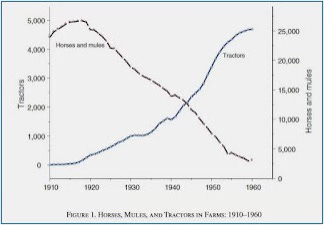
The internal combustion engine was a GPT, and another example of diffusion is tractors, as they slowly displaced horses and mules in US agriculture from 1910 to 1960. As Figure 1 shows, most of that occurred in the 30 years between 1920 and 1950. Horses and mules declined from about 26 million in 1920 to about 5 million by 1950, while the number of tractors rose from zero in 1910 to over 4 million. One reason for the slow spread of tractors was the incremental innovation needed to improve their reliability and capability, which made them more attractive over time. A second was an increase in farm wages after 1940, which made tractors more economic.
Figure 1. Tractors, horses and mules in US agriculture
In construction, diffusion is affected by two of the primary characteristics of the industry. The first is fragmentation due to the large number of small firms, which slows diffusion of technology and adoption of products because small firms have limited capacity for investment in innovation and new capabilities, and do not do R&D. Unlike manufacturing, construction is not concentrated in a few firms or a few places. Secondly, building products and processes have to conform to the relevant standards and codes. Although agreeing new standards is a lengthy process, they are universally accepted and applied because of the rigorous scientific and engineering research they are based on [2].
Technology and Structural Change in the Construction Industry
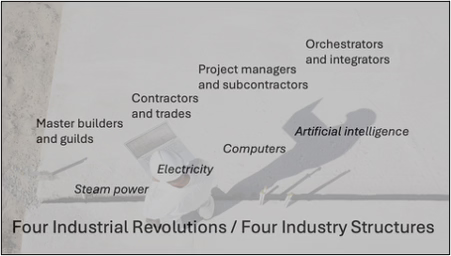
The structure and organisation of the construction industry was transformed during the transitions between the first, second and third industrial revolutions. Between the first and second industrial revolutions in the nineteenth century, the industry restructured from master builders and craft guilds to contractors and tradesmen with architects and engineers as dominant players, then in the twentieth century the project manager (PM) and subcontractor structure emerged. As Figure 1 shows, these restructurings happened as new GPTs were adopted.
Figure 2. Construction since 1800
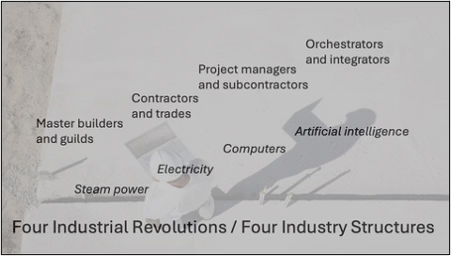
This shows the relationship between technological change and organisational form, when a new technology fundamentally changes industry practices and restructures the existing system. In the second half of the nineteenth century, with the advent of steam-powered equipment and machinery, and iron-framed and reinforced concrete buildings, the construction industry had to not only master the use of these new machines and materials but also develop the project management skills the new technology required.
Will AI be as disruptive today as steam power was in the nineteenth century? The Suez Canal, completed in 1870, was the largest project in the world at the time and the first site to be mechanised, with steam powered excavators, conveyors, cranes, tractors, railways, dredges and barges. However, it was during the construction of the Panama Canal between 1881 and 1914 that the modern form of site organisation and project management emerged, when the US military sent Goethals and his team to take over in 1904, after the first attempt at the project failed. They emphasised the design of integrated systems and processes, and introduced the use of a work breakdown structure. The driver of those changes was their use of the steam powered machinery pioneered at Suez, and this new GPT fundamentally changed existing industry practices, organisation, and system of production [3].
By the end of the twentieth century, large contractors managing major projects were the core of the construction industry. The organisation of the industry had developed a clear structure, bringing together the contractors, subcontractors, suppliers and materials needed for building and delivering increasingly challenging and complex projects, and had stabilised around very particular forms of procuring, financing and managing those projects. In many respects the industry is an exemplar, with its flexibility in adjusting to changing levels of demand and managing temporary organisations. Nevertheless, the organisation of construction will now be affected by the new GPT of AI, and associated digital technologies and platforms.
How fast and how far these, will spread through the industry over the next decades is unknowable. There are technical, regulatory and institutional barriers, so diffusion might be slow. With the various combinations of the complex array of professional institutes and organisations, government regulations and licensing, standards and codes, and insurance and finance, the ‘embeddedness’ of the current system is wide and deep. Legal and regulatory institutions interact with innovation and technology to shape the organisational form and managerial structure of firms. Because the organisation of the industry is so well established, the effects of AI could spread slowly and unevenly across the industry’s many small and medium size firms, as was case with computers.
On the other hand, if continuing innovation in big data, analytics and AI models and agents can improve project processes and productivity, they could be adopted quickly by companies that have the systems and resources to take advantage of them. AI in construction is becoming widely used in preconstruction for estimating and generative design, and for progress tracking, drone monitoring and managing equipment maintenance. The software and platforms used for design, procurement, logistics, and project management are all incorporating AI and AI agents into their systems [4].
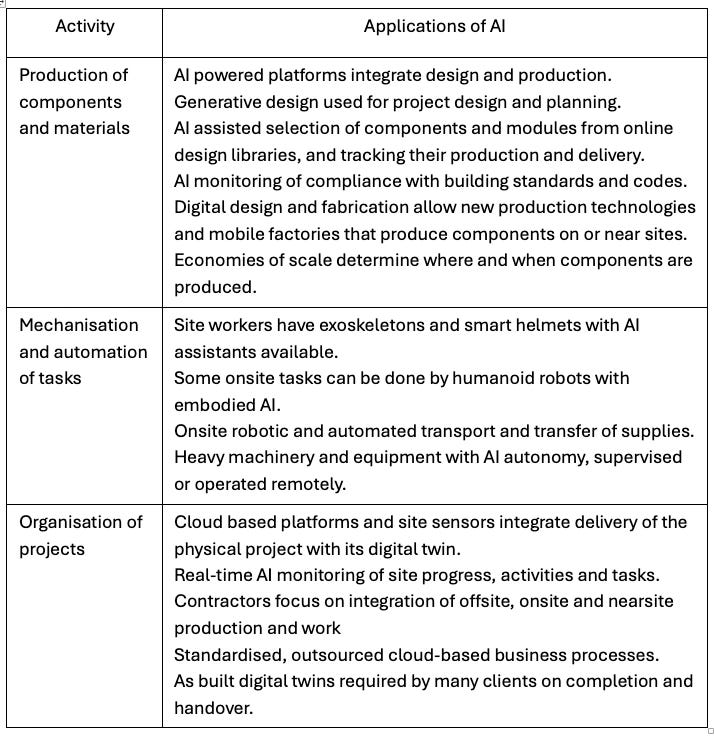
A period of rapid innovation and disruptive change led to a restructuring during the first industrial revolution. That resulted in a new form of industry organisation led by contractors instead of master builders, architects and engineers, a disruptive transition that took several decades. Then over the twentieth century contractors evolved into project managers and the traditional trades became subcontractors. During these restructurings, the effects of technological change worked through three separate but related activities: the production of components and materials, the mechanisation of processes, and the organisation of projects. AI can also be expected to work through these activities.
Table 1. Construction and AI
Four Types of Firms
How will the organisation of the construction industry be affected by digitisation and AI? While construction will be affected by AI, the path taken will be distinct and different from the path taken in other industries. This path dependence varies not just from industry to industry, but from firm to firm as well. Four types of construction contracting firms that future construction could be organised around are outlined below. There are already good examples of these four types, but they are not representative of the industry as a whole.
One possibility is that AI will be used to improve construction productivity and efficiency, but will not fundamentally alter the current industry structure with PMs and large contractors at the core. Many industry majors have developed data lakes (e.g. Bechtel, Jacobs) and internal AI capabilities (e.g. AECOM, Balfour Beatty), and these firms will continue to have a significant role in the future industry. The impact of AI on the well-developed and embedded organisation of construction might thus be gradual, changing the industry slowly over time. Business as usual continues as AI becomes integrated into existing processes.
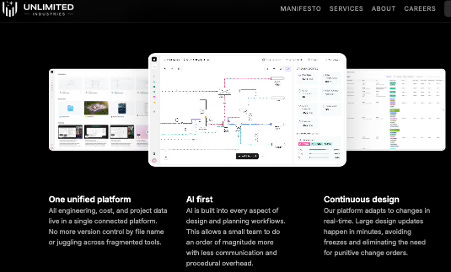
A second type of firm are ‘AI natives’, as AI powered platforms and agents allow new entrants who can leverage digitisation and AI into a viable business model. An example of an ‘AI native’ construction company is Unlimited Industries, a US startup with an AI-powered design platform that offers fixed-price contracts instead of traditional cost-plus and turns design and build into an optimization problem, without design freezes or change orders. CEO Alex Moden said ‘we do not let the contract punish the customer for learning. Iteration should be natural, not a revenue event.’
Figure 3. Unlimited Industries: ‘A new operating system for construction’
Another possibility is AI could lead to a reorganising of construction from one centred on project managers to one where contractors become orchestrators and integrators coordinating a combination digital design, site preparation and management, and a mixture of offsite, onsite or nearsite production, using prefabrication and 3D printing. UK digital builder Facit Homes has onsite microfactories that cut plywood components for assembly, and ABB is supplying sheet timber handling robots for microfactories in the US to Cosmic Buildings and in the UK to AUAR. This combination of automation, digital design, and localised production is particularly well-suited for housing. Swedish, German and Japanese prefabricated housing all have developed a combination of site preparation, digital design, and automated production.
Vertically integrated contractors might reemerge. This was the business model for the first large-scale construction companies in the nineteenth century, before mass production of materials and components. They had huge yards where they made their own bricks and tiles, had joinery and glass workshops, and employed most of the onsite workers. In the twenty-first century these large firms would combine digitised methods of managing onsite and offsite production and logistics, have internal trade, design and engineering teams, and leverage their extensive project data with AI. This is orchestration and integration on steroids.
Figure 4. Virtual design and construction
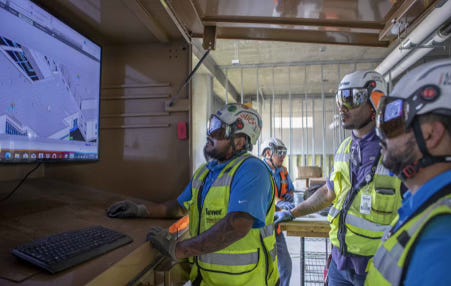
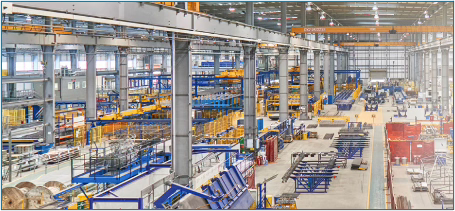
For example, US major Turner Construction has an internal self-perform group that provides trades, virtual design and construction, technical services, and specialised supply chain and procurement through its SourceBlue division. In the UK, the Laing O’Rourke Centre of Excellence for Modern Construction, established in 2010, employs 400 people in Europe’s largest pre-assembly manufacturing facility. Their DfMA 70:60:30 model ‘allows us to take 70 per cent of the construction offsite into a controlled environment, delivering a 60 per cent improvement in efficiency, and a 30 per cent improvement in project schedule.’
Figure 5. Laing O’Rourke Centre of Excellence for Modern Construction
These four types of firms are not mutually exclusive. The construction industry is diverse and firms have and will profitably pursue a range of business models and delivery methods. These four different types of firms can coexist, as they find their own clients and market segments, which would also mean they usually are not competing with each other. Different levels of AI integration are already emerging across firms and sectors, so this suggests the industry will become more differentiated and the residential, non-residential building and engineering sectors will increasingly diverge.
Conclusion
It’s a remarkable fact that the building and construction industry we have today has been developing for over 200 years, through the first, second and third industrial revolutions. Many of the industry’s global leaders are well-established, Bechtel for example is over 100 years old, and others like Hochtief, Skanska, and AECOM can trace their origin stories back over a similar period. Shimizu is over 200 years old, Kajima was founded in 1840.
The modern industry emerged during the nineteenth century, with the industrialisation of production, mechanisation of work, and organisation of projects, driven by ever larger and more complex projects building canals, roads, bridges, tunnels, railways, factories, offices and housing. The world was urbanising as heavy industry and manufacturing spread around the world, and new industries needed new types of buildings, typically larger, higher and stronger than traditional methods and materials could provide.
By the end of the twentieth century, large contractors acting as project managers were the core of construction, which had developed a deep, diverse and specialised value chain that resists integration because it is resilient, flexible and adapted to economic variability. However, for both industry majors and smaller firms a cycle of innovation has begun, offering many possibilities, opportunities and threats. This new cycle is starting more than 200 years after the first industrial revolution, and after 20 years or more of development of fundamental digital technologies like BIM, 3D printing, DfMA, digital twins and reality capture. There are many startups and new entrants leveraging digital technologies and attracting investment from outside the industry. There is potential for new entrants, new business models and disruption of the current structure of construction.
In the past, new general purpose technologies (GPTs) have had profound economic implications for the organisation of construction. These are powerful, transformative, widely used technologies that reshape economies and lead to further innovations. In the first, second and third industrial revolutions, the three GPTs were steam power, electricity and information technology. Artificial intelligence (AI) is a new GPT that underpins digital design and fabrication, automation and robotics, an interconnected set of technologies that are evolving quickly.
Technology is changing the competitive environment throughout the construction industry, which is also increasingly international. The key issue is the ability of firms in the industry to capture knowledge externalities, and adopt or adapt to these new technologies. In the various forms that AI, automation, and software platforms take on their way to the construction site, they will become central to many of the tasks and activities involved as they improve over time. Some firms will be much better than others in utilising these new technologies.
The only previous comparable period of disruptive change in the construction industry occurred during the second half of the nineteenth century, and if that is any guide we can expect technological changes to operate today over the same three areas of industrialisation of production, mechanisation of work, and organisation of projects that they did then. And today, just as in 1800 when no-one knew what the industry would look like in 1900, we can’t really see the industry in 2050 or 2100. That is a long way out, and we can only guess at the level of future technology. We can, however, use what we already know from both history and the present to form a view of what is possible over the next few decades, based on what is understood to be technologically feasible.
[1] In a 2003 paper Paul David, who did the research on US electrification, did a comparison with European countries and said a ‘point brought out by this comparative approach to the subject is that the pace of GPT diffusion may be very different in leader and follower nations, a consideration that GPT theorists have thus far largely overlooked.’
[2] An important element in a strategy to increase innovation in construction is to increase funding for standards and testing laboratories.
[3] From Peters, T. F. 1996. Building the Nineteenth Century, MIT Press, Cambridge, Mass.
[4] The previous post was an Update on AI in Construction. A earlier post was The Four Cs of Construction AI: Cost, Capability, Competence and Competition.
It has only been a few days but already an update on this post is needed.
Turner Construction launched First Equipment Corporation in February for over 40,000 trade contractors. FEC will also offer equipment rental and site services to other general and trade contractors. FEC joins prefabricator xPL Offsite, SourceBlue, the Turner Accelerated Payment Program, and the Turner Engineering Group.
https://www.turnerconstruction.com/insights/turner-construction-company-launches-first-equipment-company
Victor Murchiri’s Substack The Next Build has a great rundown of the competitive advantage Turner Construction’s self-perform operations deliver, and points out that there has been a 20 year strategy to develop them.
https://victormuchiri.substack.com/p/the-fee-trap?r=wtchb&utm_medium=ios
Data integration and analysis firm Palantir has announced their construction AI platform would be available.
https://www.palantir.com/offerings/construction/
BIM software provider Vectorworks (part of the Nemetschek Group) announced it acquired Morpholio, a developer of apps for iPad and iPhone.
The more likely productivity boom in the construction industry is going to come from the self driving vehicles revolution.
Tradies spend a lot of their time moving between worksites and AVs should free them up for other work tasks while they're travelling.
Just as you saw in AV adoption in the mining industry, you might see adoption of telerobotics in the industry enabling more women and older workers to come into the industry.
Lower transportation costs might also increase demand for prefabrication and manufactured homes.